Puzzle Lab: Advanced Cut the Rope 2 Strategies

Experiment, tweak, and perfect your moves in a colourful lab of ideas made for Canadian families who love Cut the Rope 2. Learn how to plan rope cuts, predict physics, and turn every puzzle into a clever adventure.

Difficulty: Mixed – from beginner to expert
Puzzle Lab Modules

Inside the Puzzle Lab

Each lab station focuses on one key skill. Move through them in order for a complete training path, or hop to the topic you need most for your current Cut the Rope 2 puzzle.

Module 01 · Core technique

Puzzle Lab: Mastering Rope Cuts
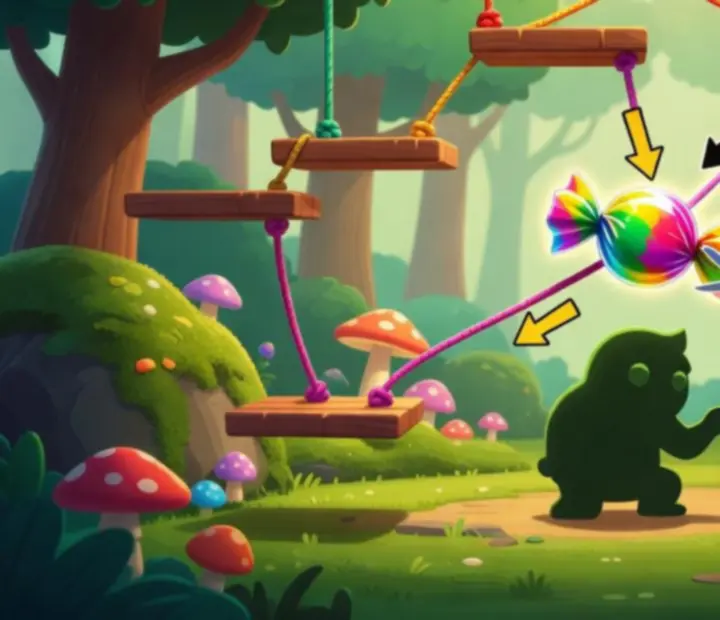
Diagram showing candy hanging from ropes with timing icons for smart rope cuts

Precise rope-cutting is the heart of Cut the Rope 2. Every cut changes gravity paths, swing angles, and where your candy will land. The goal is to cut with intention, not panic-tap your way through the level.

When and where to cut

  • Pause before cutting: Trace where the candy will swing and which stars it can touch first.
  • Cut highest ropes last: Lower ropes often steer the candy gently while top ropes create larger swings.
  • Use “one-star” test cuts: On your first run, focus on grabbing just one safe star to read the level’s movement.
  • Avoid double-cuts: Cutting two ropes at once can cancel the helpful swing you needed.

Planning smart cut sequences

  • Think in 3 steps: Launch, Collect, Land. Plan how each cut moves you through those stages.
  • Use ropes as brakes: Sometimes leaving one rope attached lets the candy slow down before a precise drop.
  • Cut with the challenge in mind: A safe cut for feeding Om Nom might be too slow for time trials or fruit runs.
  • Replay for refinement: Once you understand the path, replay and adjust cut timing by fractions of a second.

Lab note: If you are repeatedly missing a star by a tiny margin, try cutting slightly earlier to gain more swing, or slightly later to tighten the swing arc.
Module 02 · Physics intuition

Predicting Physics: Movement and Momentum

You do not need to be a scientist to understand Cut the Rope 2 physics. You only need to notice how the candy behaves after each cut and use that pattern to your advantage.

Simple physics ideas for every player

  • Gravity: The candy always falls down, so any extra height is a chance to pass more stars on the way.
  • Momentum: Once the candy is moving, it wants to keep going in that direction. Time your cuts so movement carries it toward stars and fruit.
  • Swinging: Long ropes create bigger, slower swings; short ropes create quick, tight swings that help with precise drops.
  • Bounces and bumpers: Use walls, boxes, and platforms as safe bumpers to redirect the candy’s motion instead of stopping it completely.

How to predict the next move

  • Shadow tracing: Before you cut, imagine a faint trail where the candy will swing or fall. Adjust your cut if the trail misses a star.
  • Watch the first cycle: Let the candy swing once before cutting. The swing pattern tells you the best cut moment.
  • Use small test cuts: Cut a non-critical rope first and see how the level reacts before committing to the full sequence.
  • Chain reactions: Some puzzles trigger platforms, balloons, or Nommie actions. Plan your cuts as part of a chain instead of individual moves.

Lab note: If a puzzle feels chaotic, focus on repeating just the first cut and watching what happens. Once that first move is predictable, add the second, then the third.

Module 03 · Character synergy

Smart Use of Nommies

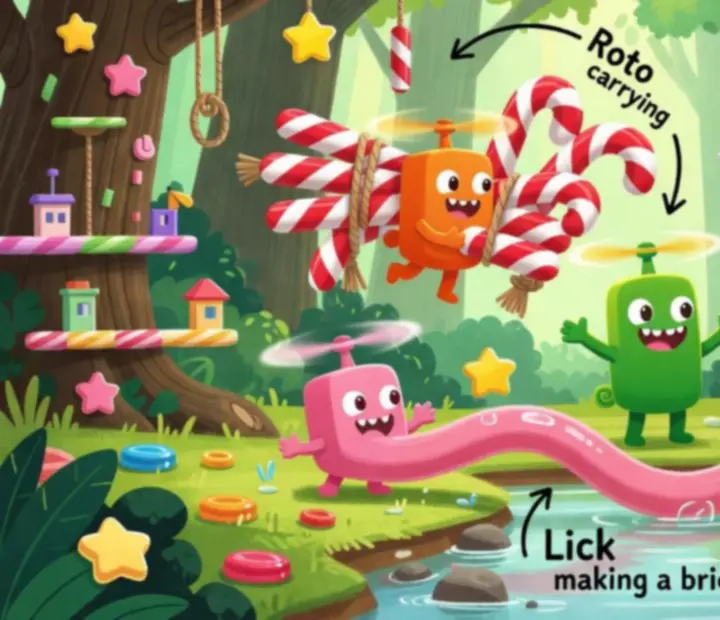
Strategy diagram showing helper creatures working together to solve a puzzle

Nommies turn tough puzzles into playful experiments. Each helper has a favourite job, and combining them is often the secret to three stars and extra fruit.

Key Nommie roles

  • Roto: Best for moving Om Nom to high ledges or central platforms before you start cutting ropes.
  • Lick: Uses its tongue as a temporary bridge to cross gaps or support candy.
  • Blue: Duplicates and lifts candy or Om Nom upward, giving extra height for star collection.
  • Toss: Throws candy or objects, great for reaching distant stars or fruit.
  • Boo: Scares Om Nom into jumping or moving, useful for timing-based landings.
  • Snailbrow: Slides along walls and ceilings, pushing objects into the perfect position.
  • Ginger: Burns obstacles, clearing blocked paths when normal movement is impossible.

Best situations and combos

  • Roto + Lick: First move Om Nom into place with Roto, then create a bridge under the candy with Lick for a controlled roll.
  • Blue + Toss: Use Blue to gain extra height, then let Toss fling candy from above to sweep through hard-to-reach stars.
  • Boo + Snailbrow: Scare Om Nom onto a moving platform or Snailbrow’s path to ride along walls safely.
  • Ginger + fruit: Clear burning obstacles early so you can focus only on timing runs for fruit and medals.

Common Nommie mistakes

  • Activating a Nommie too early and blocking a later star path.
  • Relying on Toss for every throw instead of using swings and gravity to help.
  • Leaving Snailbrow idle instead of parking objects exactly where you want them.
  • Forgetting that some Nommies can be used more than once if you reset the situation.

Lab tip: When you discover a useful Nommie combo, try it again in other worlds—many strategies repeat with small twists.

Module 04 · Completion goals

Solving for Stars: Maximizing Rewards

Earning all three stars in every level keeps your progression strong and unlocks more medals and brag-worthy records. Instead of hoping to grab stars by luck, plan your route with star collection in mind.

Planning a 3-star route

  • Identify “must-pass” stars: Some stars sit directly on the main path—those should be free pickups.
  • Spot tricky stars: Note which stars require an extra swing, bounce, or Nommie action.
  • Separate learning runs: First solve the level safely, then replay with a focus on the hardest star.
  • Watch candy speed: Fast candy can skip past stars; slow it down with ropes, bumpers, or Nommie support.

Handling hard-to-reach stars

  • Use wide swings: Cut earlier to stretch the swing so the candy arcs through side stars.
  • Bounce intentionally: Aim the candy at walls or platforms to curve back toward stars.
  • Try reversed order: Sometimes grabbing the farthest star first makes the rest easier.
  • Consider replay value: If one star costs you the main objective, finish the level, then replay just for that star.

Lab note: Think of each level as a short puzzle series: one run to understand it, one run to secure three stars, and extra runs for fruit and time challenges.

Module 05 · Path planning

Advanced Candy Path Planning

Advanced players treat candy movement like drawing a secret map. The better you can picture that path, the easier it is to dodge traps, grab collectibles, and land safely with Om Nom.

Drawing invisible routes

  • Connect the dots: Mentally link candy, stars, fruit, and Om Nom with a curved line.
  • Mark danger zones: Imagine red areas where candy must not fall—spikes, gaps, or dead ends.
  • Use checkpoints: Plan where the candy should be after each cut: left platform, centre star, right ramp, and so on.
  • Adjust by replay: If the candy lands slightly short or long, tweak your “drawn” path and try again.

Handling environmental twists

  • Moving platforms: Time your cuts so candy meets the platform while it is under a star.
  • Wind or motion: Treat air gusts and motion pads as extra curves in your drawn route.
  • Multi-layer layouts: Think in layers—top layer for setup, middle for star collection, bottom for safe landing.
  • Backup routes: Keep a second path in mind if your first swing goes wrong.

Lab note: Younger players in your family can point to the screen and trace the expected route with their finger before tapping. Turning planning into a mini-game keeps learning fun.

Module 06 · Challenge modes

Winning Fruit and Beat-the-Clock Challenges

Strategy board highlighting fruit collection and time limit icons

Every level offers more than just feeding Om Nom. Fruit challenges and time trials add exciting extra goals that reward medals, coins, and progress.

Collecting fruit efficiently

  • Learn the base route first: Beat the main puzzle without worrying about fruit. Then replay with a fruit-only mindset.
  • Take wide arcs: Plan swings that pass through multiple fruit or stars in one motion.
  • Use Nommies as ladders: Roto, Blue, and Lick can lift or support candy so you can climb through fruit clusters.
  • Accept longer paths: Fruit runs are often slower but more precise—speed is for time challenges.

Beating time limits

  • Memorize before rushing: Play a few slow practice runs so you know every swing and bump.
  • Tap with rhythm: Time cuts to natural swing points instead of random fast taps.
  • Skip bonus moves: For time trials, ignore extra stars or fruit if they force a longer route.
  • Restart quickly: If the first move fails, restart right away to protect your timer.

Lab note – Fruit medals: Completing fruit challenges across a world is a major step toward 100% completion and earns valuable recognition in your profile.

Lab note – Time medals: Treat time challenges as mini-speedruns. The solution is usually the same as the main level, just with cleaner timing.

Module 07 · Steady progress

Avoiding Common Beginner Mistakes

New Cut the Rope 2 players often lose stars or fruit for simple, fixable reasons. Cleaning up these habits makes the game more rewarding for kids and adults alike.

Habits that hold you back

  • Rapid-fire cutting: Tapping too fast removes the chance to read swings and plan.
  • Ignoring Nommies: Treating helpers as decorations instead of puzzle tools.
  • Chasing everything at once: Trying to grab stars, fruit, and beat the clock in a single run.
  • Skipping replays: Moving on after a messy win instead of replaying for cleaner three-star results.

Better habits to build

  • Count before cutting: For swinging candy, quietly count “1–2–cut” at the peak of the swing.
  • Play in modes: One run for feeding, one run for stars, one run for fruit, one run for time.
  • Talk it through: When playing with kids, ask what they think will happen before each cut.
  • Learn from failure: After a miss, say what went wrong out loud and adjust the next attempt.

Lab note: Cut the Rope 2 is designed for experimentation. Treat “mistakes” as data for your next, smarter attempt rather than something to be frustrated about.

Module 08 · Resource strategy

Power-Up Precision: When to Spend or Save

Power-ups, special candies, hats, and finger traces are fun, but they are also limited. Strategic use keeps the game challenging and satisfying while supporting long-term progress.

Smart spending rules

  • Beat it once without boosts: Try to clear each level on your own before using any help.
  • Reserve power-ups for medals: Spend them when you are chasing tough time or fruit medals.
  • Support younger players: Use power-ups to help kids clear frustrating spots while you explain the solution.
  • Avoid auto-usage: Do not activate a power-up just because it is available—always ask “what do I gain?”

Picking the right tool

  • Finger traces: Great for visual learners; draw the ideal path and then try to copy it without the guide later.
  • Special candies: Use them when normal swings cannot reach a final star or fruit.
  • Hats and cosmetics: Enjoy these as rewards and style perks—they keep the game fresh without affecting core difficulty.
  • Other boosts: Save rare boosts for worlds where you are stuck on the last few levels.

Lab note: A good rule for families is to talk about why you are using a power-up before activating it, so kids learn to plan resources instead of spending them on impulse.

Module 09 · Expert walkthrough

Expert Problem Solving: Tough Puzzle Walkthroughs

For especially challenging levels, a clear thought process can be more helpful than a step-by-step copy. Use this sample walkthrough as a model for solving your own tough puzzles.

Step 1 – Read the whole level

  • Scan for Om Nom, candy, ropes, stars, fruit, Nommies, and any moving parts.
  • Decide your final goal order: feed, then stars, then fruit, then time, for example.
  • Note which elements you cannot control (like gravity) and which ones you can (ropes, cuts, helpers).

Step 2 – Build a plan

  • Choose a starting rope to cut that safely begins motion without losing stars.
  • Assign Nommies to specific jobs: one for lifting, one for bridging, one for clearing obstacles.
  • Sketch a three-step sequence: setup, collection, delivery.

Step 3 – Execute with timing

  • Cut the first rope and wait for a full swing cycle before acting again.
  • Trigger Nommies only when the candy or Om Nom is in the right zone.
  • Adjust your cut timing by tiny amounts to catch stars or avoid hazards.

Step 4 – Refine for challenges

  • Once you have a consistent clear, replay focusing on squeezing in more stars or fruit.
  • For time challenges, remove any extra swings or detours from your path.
  • If one part keeps failing, isolate just that sequence and practise it.

Lab takeaway: Every difficult level is a chance to practise a full problem-solving loop: observe, plan, test, refine, and celebrate. Over time, this loop makes even new puzzles feel familiar and manageable.

Continue Your Cut the Rope 2 Adventure

Put your new Puzzle Lab skills to work across every environment and challenge. Explore detailed guides, character breakdowns, and collectible strategies crafted for Canadian players and families.